Australian phone number search
Why Australians check phone numbers: StoryCheck data 2026
By the StoryCheck team · 7 min read · Published
Between 1 July and 28 September 2026, people in Australia started more than 20,000 phone lookups on StoryCheck. The reason they chose most often was private photos online (36%), followed by dating app activity (28%), spam or scam callers (17%), what people say about them (12%) and reputation (8%). Nine in ten numbers checked were mobiles, and 98% were Australian numbers.
What do the figures show at a glance?
20,000+
Lookups from Australia
1 July to 28 September 2026
36%
Private photos online
the most common reason given
28%
Dating app activity
the second most common reason
17%
Spam or scam callers
roughly one lookup in six
90%
Mobile numbers
the other 10% were landlines
98%
Australian numbers
only 2% came from overseas
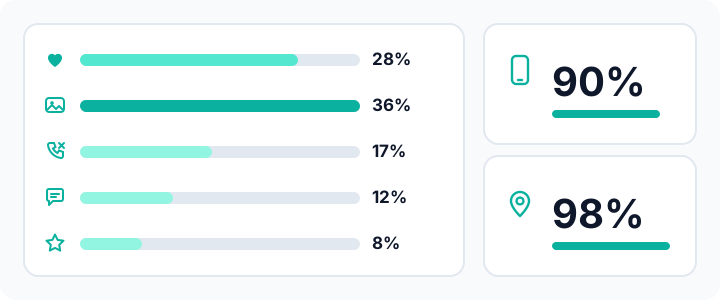
Why do people in Australia check a number?
When someone starts a lookup, the form asks what matters most to them, and they pick one answer. These figures are what people said they wanted to know, not what any lookup found.
| Reason chosen | Share | What choosing it means |
|---|---|---|
| Private photos online | 36% | Concern about private or intimate photos being online |
| Dating app activity | 28% | Wanting to know whether someone is active on dating apps |
| Spam or scam callers | 17% | Identifying, and then blocking, an unwanted or suspicious caller |
| What people say about me | 12% | Checking what is being said about them online |
| Reputation | 8% | Looking after their own reputation online |
More than eight in ten lookups in Australia, then, are about something personal rather than a nuisance caller, and the two biggest reasons, private photos and dating apps, make up 64% between them. For the dating question, is my partner on dating apps sets out honestly what a number can and cannot show. The photo question has its own section below.
How does Australia compare with other countries?
| Reason or measure | Australia | UK | Germany | France | Netherlands |
|---|---|---|---|---|---|
| Private photos online | 36% | 45% | 32% | 37% | 26% |
| Dating app activity | 28% | 30% | 33% | 39% | 25% |
| Spam or scam callers | 17% | 7% | 13% | 5% | 34% |
| What people say about me | 12% | 13% | 18% | 13% | 10% |
| Reputation | 8% | 5% | 4% | 5% | 6% |
| Mobile numbers | 90% | 97% | 87% | 98% | 82% |
| Domestic numbers | 98% | 96% | 87% | 94% | 91% |
Three things stand out. Australia has the highest share choosing reputation of all ten markets StoryCheck measured, at 8%. Private photos rank higher only in the UK (45%) and France (37%). And people in Australia are more than twice as likely as people in the UK to be checking a scam caller, at 17% against 7%, though well behind Belgium and the Netherlands, at 34% each.
Dating app activity, meanwhile, matters less in Australia (28%) than in most of Europe. It is the top reason in six of the ten markets, and peaks in Norway (45%), Denmark (40%) and France (39%).
What kinds of numbers are Australians checking?
Nine in ten numbers checked from Australia were mobiles and one in ten was a landline. That shapes how you can search: Australian 04 mobiles appear in no public directory, which is why free searching so often comes up empty for them, as our guide to free Australian number searches explains. The Australian prefix guide covers what each range means.
| Country code | Country | Share of foreign numbers |
|---|---|---|
| +1 | United States or Canada | 27% |
| +64 | New Zealand | 18% |
| +44 | United Kingdom | 6% |
| +63 | Philippines | 5% |
| Other codes | Rest of the world | about 44% |
Only 2% of the numbers were foreign, the second-lowest share of the ten markets after Denmark. New Zealand numbers alone made up almost a fifth of those, and +1 numbers can belong to the United States or Canada, which share the code. A foreign number that rang once and hung up is the classic setup for the one-ring callback scam. Across all ten markets, checks peak in the afternoon, between 2pm and 5pm local time.
How do the scam caller checks fit the national picture?
The 17% of Australian lookups about spam or scam callers sit against a national picture that is shifting. According to the National Anti-Scam Centre's Targeting Scams report for 2025, reports to Scamwatch about scam texts fell 62.4% in a year, from 77,365 to 29,058, although losses by text still rose to $17.9 million. Phone scams were reported less often too, but stayed costly, with $72.5 million lost and a median loss of $3,800.
Telcos reported blocking 492.7 million scam calls and 153.5 million scam texts in 2025 under ACMA's anti-scam code, and since 1 July 2026, texts sent under an unregistered brand name arrive labelled 'Unverified'. If a number is already bothering you, how to stop unwanted calls covers the Do Not Call Register, blocking and where to complain.
What can you do if you're worried about private photos online?
Because this is the single biggest reason people in Australia give, it deserves a straight answer. A phone lookup cannot search private messages, closed groups or intimate images, and nothing lawful can. These are the routes that help:
- If an intimate photo or video of you has been shared without your consent, report it to eSafety, which can help get it removed. If someone is threatening to share one, do not pay, save the evidence and report the account to the platform, then to eSafety if the platform does not help.
- Since September 2024, sharing sexual material of an adult without consent, including deepfakes made with AI, has been a standalone Commonwealth offence carrying up to six years in prison. Report it to police through ReportCyber or on 131 444.
- 1800RESPECT, on 1800 737 732, offers confidential support around sexual, domestic and family violence 24 hours a day.
- If your worry is that photos someone sent you are not really theirs, a reverse image search shows where else the same picture appears.
How was this data collected?
- Source: anonymous, aggregated phone lookups started on StoryCheck by visitors located in Australia, based on their IP address.
- Period: 1 July to 28 September 2026, more than 20,000 lookups in total.
- Reason: the one answer each person chose when the form asked what mattered most to them.
- Line type and country: taken from the telephony data at the moment of the lookup. Foreign origins are shares of foreign numbers only.
- Rounding: every figure is rounded, so a row can add up to 99% or 101%.
- Privacy: only aggregated figures were analysed, with nothing about any individual person or number.
These figures describe what people wanted to know, not what they found. 28% choosing dating app activity says nothing about how many of the people whose numbers were checked use dating apps. The data comes from people who use StoryCheck and is not a survey of all Australians. To cite it, please use: StoryCheck lookup data, Australia, July to September 2026.
Common questions
Why do people in Australia look up phone numbers?
In StoryCheck lookup data from July to September 2026, the most common reason was private photos online (36%), followed by dating app activity (28%), spam or scam callers (17%), what people say about them (12%) and reputation (8%). These are the reasons people chose, not the results they got.
What share of numbers checked in Australia are mobiles?
90% of the numbers checked from Australia between July and September 2026 were mobiles and 10% were landlines. 98% were Australian numbers, and only 2% came from overseas.
Which foreign numbers do Australians check most?
Only 2% of the numbers checked were foreign. Of those, 27% were +1 numbers from the United States or Canada, 18% came from New Zealand, 6% from the UK and 5% from the Philippines.
Does this mean 28% of partners are on dating apps?
No. The figure shows what people said they wanted to know when they started a lookup. It says nothing about the behaviour of anyone whose number was checked.
Can I quote these figures?
Yes. Please cite them as StoryCheck lookup data, Australia, July to September 2026, and describe the reasons as what people said they wanted to know rather than as findings.
Related guides
Find out who is really behind the number
The check is private and takes about 60 seconds. The person is not notified and never finds out you looked.
Check a number now